
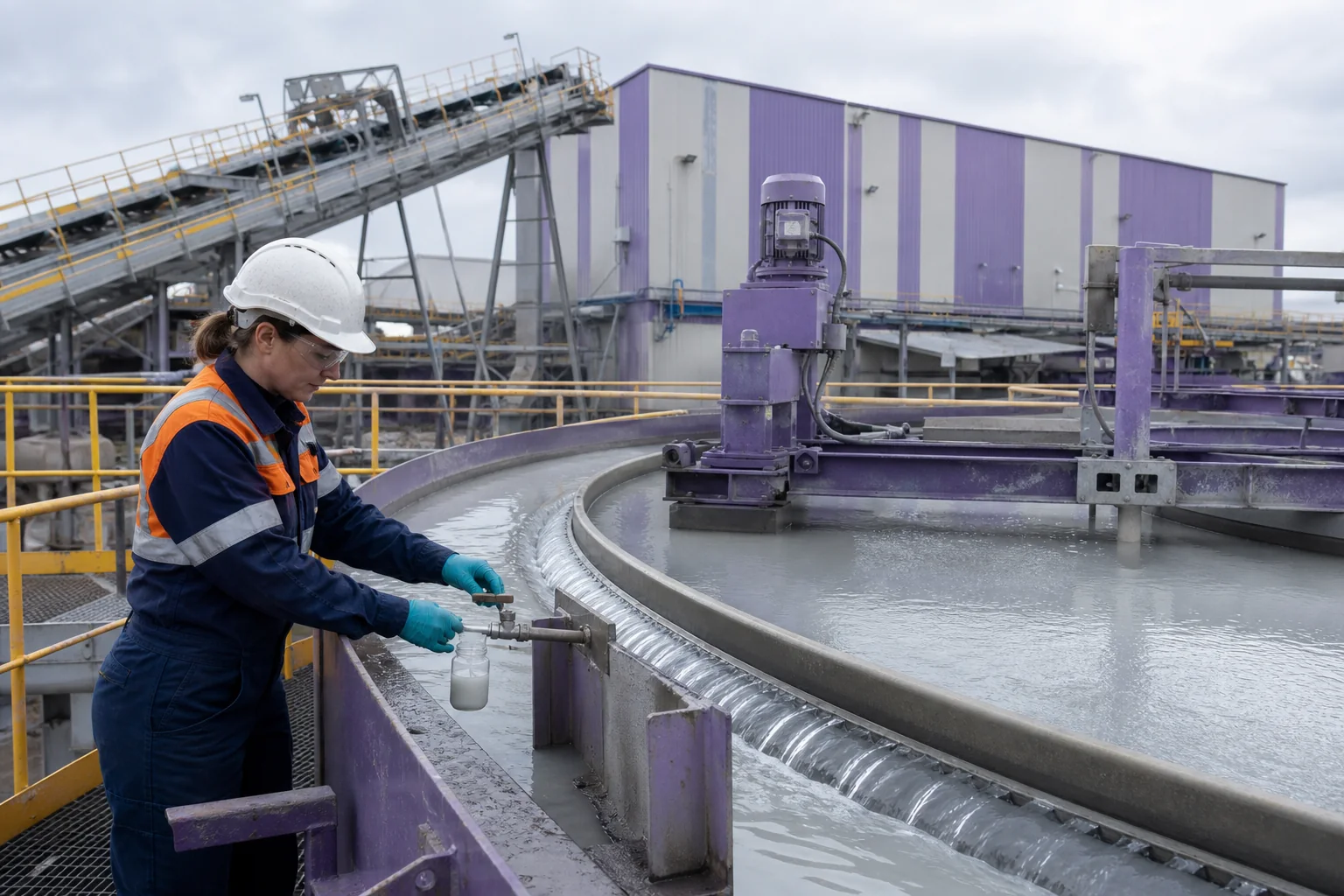
Mineral-processing return water can contain ultrafine quartz or clays, calcium and magnesium ions and residual process reagents. Nonionic PAM can be screened for bridging, but both water recovery and the effect of recycled chemistry on beneficiation must be evaluated.
Build a representative sample
Record ore campaign, grinding, mineralogy, particle-size distribution, solids, pH, conductivity, hardness and collectors, frothers, dispersants or leach reagents. Sample the established recycle circuit rather than fresh water alone.
Homogenize without losing fines or applying uncontrolled shear. Include normal and difficult feed conditions.
Measure separation and return-water effects
Compare interface velocity, supernatant turbidity, sediment volume, compaction and response after defined shear. At plant scale include overflow solids, underflow handling, water recovery and any change in flotation, magnetic separation or washing.
Do not inject a flocculant into a flotation stage without a circuit-specific test; adsorption on mineral or coal surfaces can change selectivity.
Approve the complete circuit
Select the product and dose that meet both separation and downstream reuse requirements. Keep the lot, preparation, test sheet and plant results with the purchasing record.