
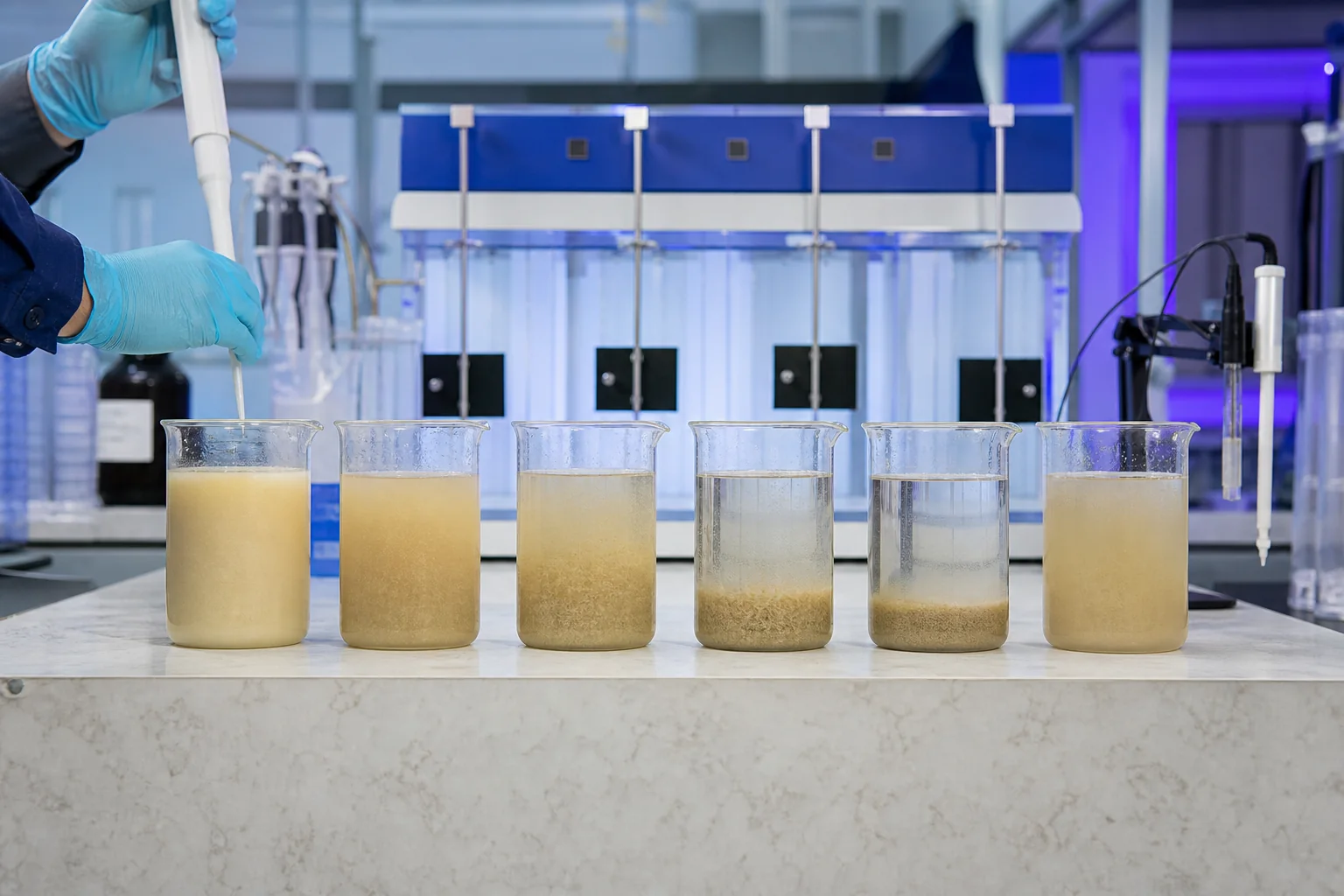
Nonionic PAM is a near-neutral polyacrylamide family selected mainly for adsorption and bridging rather than strong charge neutralization. The useful product is defined by the actual suspension, water chemistry, mixing and separator—not by the nonionic label alone.
Choose the performance profile
High-molecular-weight candidates are screened when long-chain bridging and rapid aggregation of fine solids are required. Low-hydrolysis candidates preserve near-neutral ionic character for uncertain or weakly acidic feeds. Fast-dissolving candidates address limited make-down residence, but dissolution must be confirmed rather than assumed from a specification line.
The three profiles are starting points. A representative jar or settling test must compare preparation, active dose, floc growth, shear response, supernatant and downstream handling under identical conditions.
Record chemistry before assigning a grade
Include pH, conductivity, hardness, dissolved metals, suspended-solids concentration, particle or precipitate identity and any coagulant, collector, frother, dispersant or neutralization chemical. Near-neutral polymer does not mean chemistry-independent performance.
Where PAC, alum, ferric or lime creates the primary microfloc, test nonionic PAM as a separate bridging step. Keep the primary treatment fixed while polymer candidates are compared.
Approve a controllable operating window
Locate underdose and overdose, then choose a middle band that survives normal feed movement. Compare active polymer per dry solids and measure the endpoint that controls production: overflow turbidity, settling flux, filtrate quality, cake behavior or fines recovery.
Send the complete case through the nonionic PAM trial worksheet for a focused sample set.