
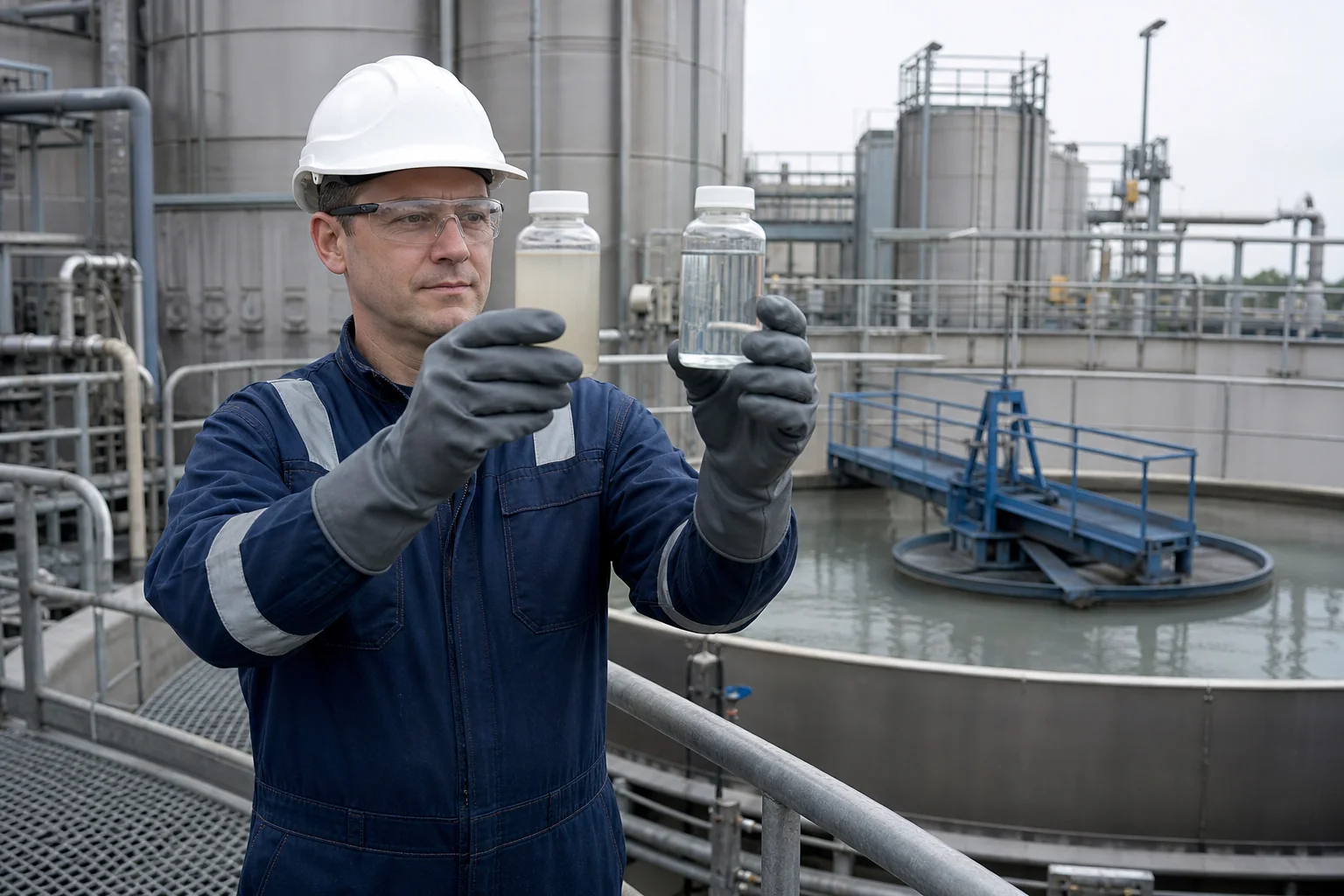
Acidic pH is a reason to test nonionic PAM, not proof that it will work. Product choice begins after the treatment chemistry has created suspended solids that can be bridged and separated.
Define what the process must remove
Separate suspended solids from dissolved metals, color, dissolved organics or other regulated constituents. Record the production source, batch variation, temperature, pH, conductivity and the analytes that control discharge or reuse. Polymer can enlarge particles; it cannot complete a missing precipitation reaction.
Collect a representative difficult sample as well as normal feed. Preserve it appropriately and note any change in pH or solids during storage.
Stabilize neutralization and coagulation
Set the required pH and primary coagulant before comparing polymers. Run blank, neutralized-only and coagulant-only controls. Keep rapid mixing, reaction time and sampling point consistent so a change in precipitate formation is not mistaken for a polymer effect.
When PAC, alum or ferric is used, treat nonionic PAM as a distinct bridging stage. Vary one chemical at a time during the initial screen.
Compare a useful candidate set
Include two nonionic molecular profiles and at least one relevant ionic alternative when the particle charge is uncertain. Prepare every product at equal active concentration with the same water, maturation and solution age. Dose against dry solids where possible.
A compact screen is more informative than many unrelated products. Repeat the best two candidates on fresh feed before scale-up.
Measure more than visual clarity
Record floc formation time, settling velocity, supernatant turbidity or suspended solids, sludge volume, filtration, cake release and residual treatment endpoint. Use the same settling time. A clear jar reached after an impractical delay is not a plant solution.
Note stringy floc, haze, floating material and poor compaction as possible overdose or mismatch signals.
Build the operating range
Test below and above the apparent optimum. Select a middle range that remains controllable as pH, solids and coagulant demand move. Normalize consumption to active polymer and calculate cost with sludge handling and water recovery included.
Send a decision-ready enquiry
Provide the process, pH window, dissolved and suspended measurements, coagulant sequence, separator, current dose, target, quantity and destination. Link the record to the acidic wastewater application brief.
Set acceptance limits before testing
For an acidic industrial-water selection, write the acceptance condition before polymer is added. Define the feed range, sampling point, baseline treatment and operating time represented by each sample. A trial cannot be compared fairly if the feed or primary chemistry changes while candidates are being ranked.
Use a numerical or clearly observable endpoint: treated-water turbidity or solids, regulated constituent result, sludge volume and filter behavior. Record the method, sample timing and instrument condition. Include an operating constraint such as residence, pump capacity, filter cycle or downstream recovery so a visually attractive result does not hide a plant penalty.
Bracket normal feed variation
Build at least two feed cases around low and high pH, suspended solids and coagulant demand. Test the same candidate set and active-dose steps on both. A narrow optimum on one easy sample is less useful than a broader response that remains controllable through the expected production envelope.
Keep preparation water, stock concentration, maturation, solution age and mixing sequence identical. When one variable must change, run a bridge comparison so the chemistry effect can be separated from the preparation effect.
Read the full response curve
Plot the blank, current product and candidate results against active dose. Mark the first useful response, the stable operating region and the point where more addition gives no benefit or reverses performance. Repeat the middle and high points before deciding that overdose has been located.
When clarity improves without the required dissolved-constituent result, or floc disappears after transfer, stop changing several variables together. Check sample integrity, precipitation or coagulation, polymer stock, dose calculation, distribution and shear in that order. Only then compare a different molecular or ionic profile.
Carry the result into the plant
For scale-up, hold neutralization and coagulant fixed, begin near the center of the bench dose window and verify sludge withdrawal and filtration. Allow the full hydraulic or recycle residence after each change. Collect feed and product samples at matched times, keep equipment settings stable and record operator observations alongside laboratory measurements.
Convert pump settings and solution flow back to active polymer consumption. Reconcile the calculated value with inventory over a stable period. Differences often expose feeder calibration, tank turnover, dilution or recirculation errors that were invisible in the jar test.
Close the technical and purchasing record
Retain the product code, lot, preparation sheet, dose curve, photographs, instrument readings and plant result. State the approved feed range and the condition that requires retesting. This keeps a successful sample connected to the material later ordered and received.
Request COA, TDS and SDS for the exact grade. Compare packaging, freight, storage, make-down demand, active consumption and separation value as delivered treatment cost. Do not replace application evidence with a single molecular-weight, viscosity or hydrolysis number.