
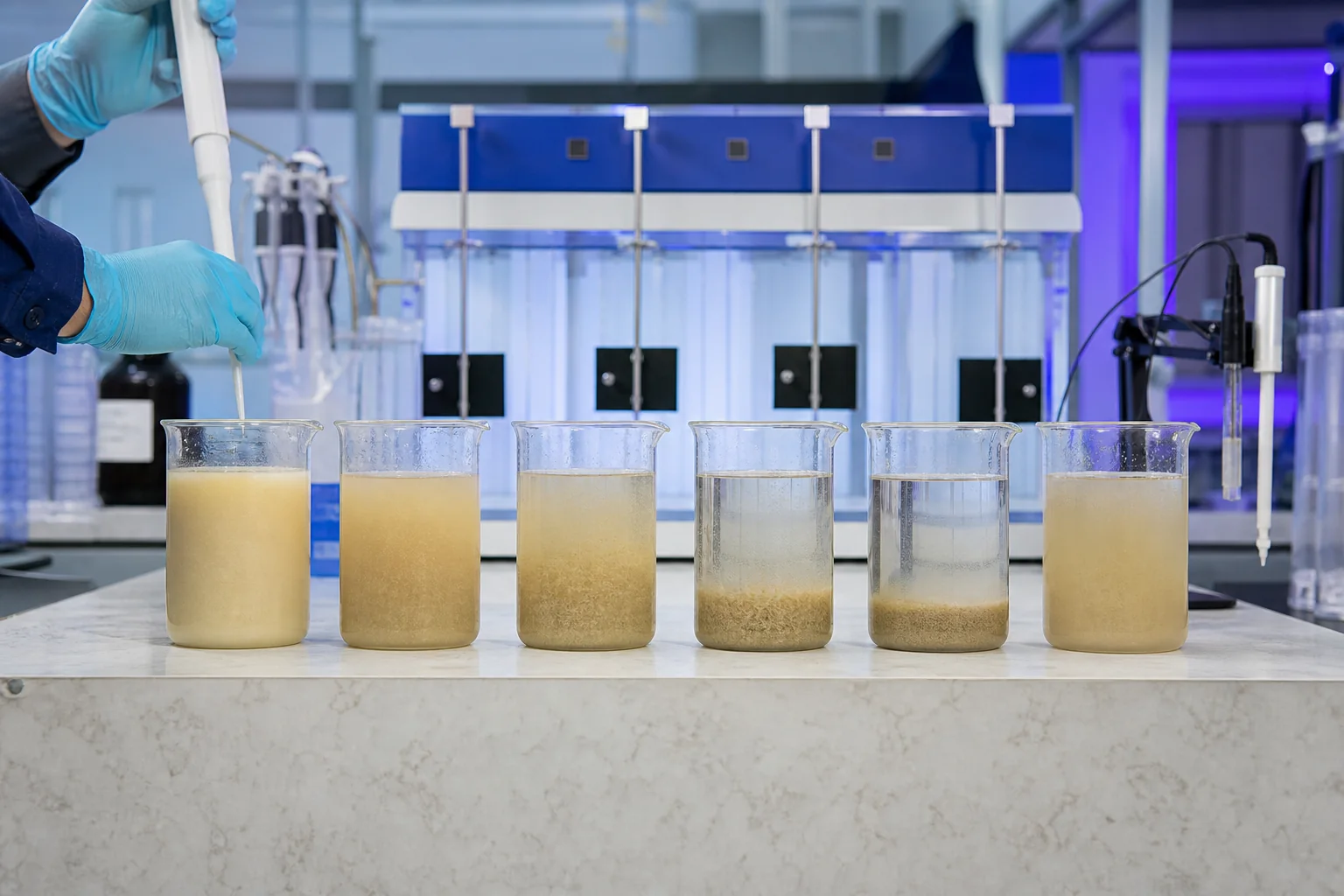
Kaolin residual-water clarification is not the same objective as keeping a saleable product slurry dispersed. A nonionic PAM enquiry must specify which particles should be separated and where the treatment occurs. Use actual chemical history and a defined recovery-water duty rather than an assumed clay grade.
Distinguish residual recovery from product use
Identify the sample point and purpose, solids range and relevant dispersants or upstream reagents. State which product process remains outside the trial. Changing particle chemical history can materially alter response. A clean clay suspension prepared solely for demonstration may not reproduce the residual stream. Explain the collection and splitting method so the difficult fine fraction remains represented.
Compare the bridging hypothesis fairly
Screen a focused nonionic set with relevant alternatives using consistent preparation and active dose. Hold upstream conditioning fixed. The family comparison guide avoids treating either low charge or the kaolin name as a universal selection rule. If the curve is flat, inspect method and chemistry before simply increasing a nominal nonionic dose.
Measure water and sediment together
Record settling, recovered-water quality, compaction and the downstream residual route. Include filtration when it matters. Fast aggregation can produce a persistent loose bed, so one interface observation is insufficient. Review filtration purchasing requirements for that route. A successful residual-water comparison cannot qualify the product for an unrelated kaolin formulation or quality-sensitive production point.
Keep the approved application on the order
Specify candidate identity, stream purpose, preparation and demonstrated range. Estimate consumption from the measured duty and confirm delivery scope. If dispersant use or stream routing changes, revisit qualification. Avoid a vague order description that allows the supplier code to be used throughout the production circuit. Retain both the useful result and the boundary of what was actually tested.
Keep an approval worksheet
Record the measured result or agreed document reference for each item. A missing observation remains a qualification limit, not an assumed pass. Use the same candidate identifier throughout sampling, quotation and receiving so a successful comparison cannot be transferred to an unreviewed product or process condition.
| Requirement | Evidence | Approval decision |
|---|---|---|
| Purpose | Residual-water versus product-dispersion boundary | Quote targets the correct process objective |
| Chemistry | Dispersant history and paired screen | Near-neutral fit is tested, not presumed |
| Useful result | Water, bed and residual handling | Approval reflects the full recovery duty |
Prepare the sample and quotation request
Provide the residual stream and its purpose, relevant dispersants, solids, water and separator. Include the dose comparison and recovered-water requirements. State explicitly which product-slurry point is excluded from the proposed polymer application.
Include quantity, packaging and destination alongside the operating record. The nonionic PAM sample worksheet helps define the comparison; the quality and supply requirements keep the approved product connected to its shipment. Gongyi Xinqi Polymer Co., Ltd. can review the application and commercial scope. Confirm grade suitability, delivery availability and terms for the selected candidate rather than infer a guaranteed result from the nonionic label.
Request a focused product review
Send feed, separator and purchasing requirements for the intended duty.