
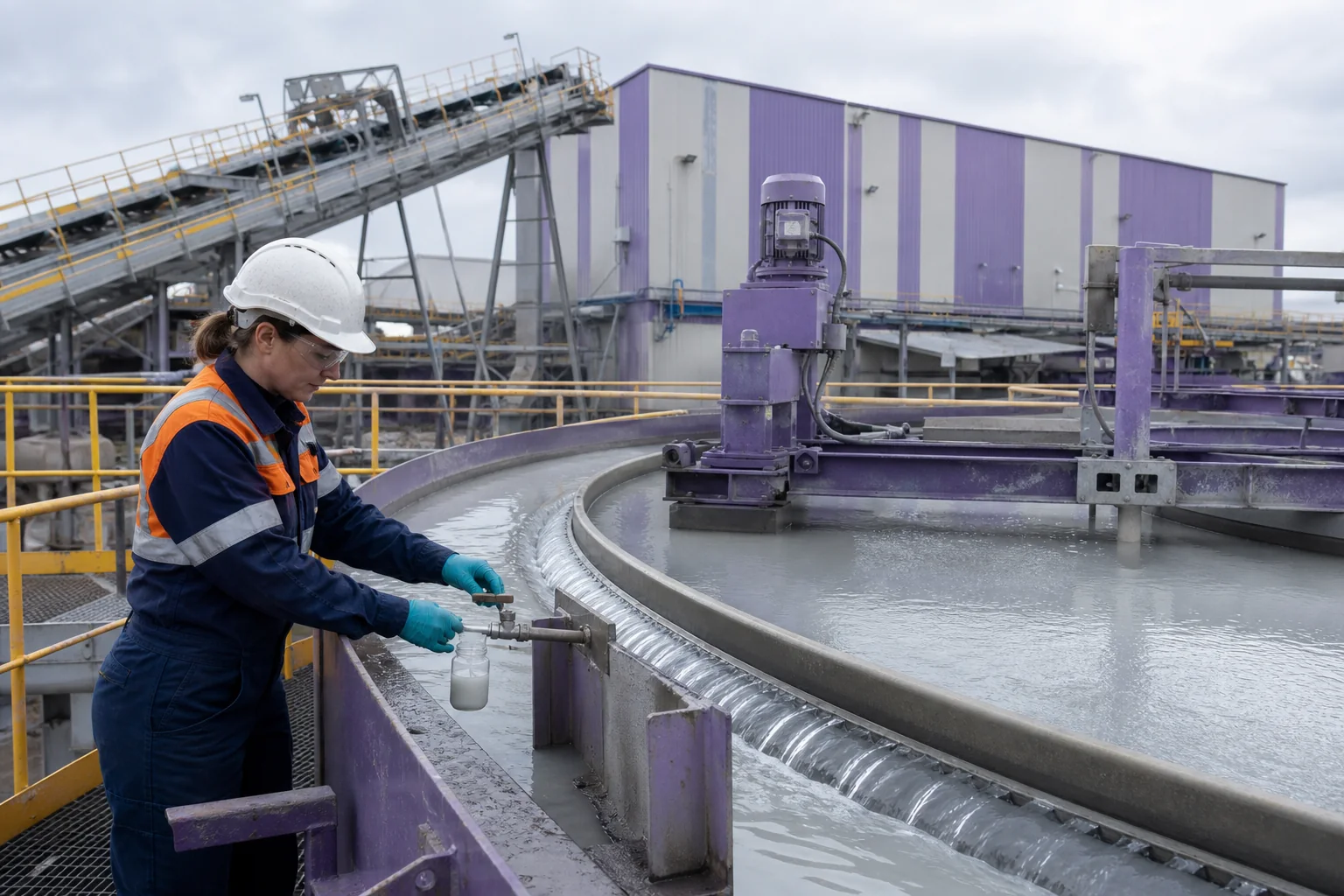
Silica-fines water can justify testing a nonionic candidate, but the mineral name does not determine the winner. Water chemistry and upstream reagents affect the particle condition presented to treatment. Request samples for the real recovery circuit and judge the useful result before supply is approved.
Represent the actual fines stream
Record collection point, fine-particle information, solids and relevant water measurements. Include reagents and normal recycle condition. A washed demonstration sample may omit the surface history that controls response. Explain difficult feed periods and how samples are split. The supplier should know whether clarification or residual dewatering is being purchased rather than infer a product-quality guarantee from the silica name.
Compare a meaningful candidate range
Prepare nonionic and justified alternatives with controlled water, concentration and aging. Compare active-dose curves and reference results on the same feed. The comparison procedure prevents a low-charge label from replacing the experiment. Record practical timing and transfer, not just an impressive floc after a long quiet settling period.
Define recovered-water acceptance
Agree which properties matter to the intended reuse destination. Settling fines may improve suspended-solids quality without resolving every dissolved constituent or carryover concern. Include downstream filtration or production checks where relevant. Use the return-water trial record to connect clarification and reuse rather than assess them as unrelated purchasing decisions.
State product approval and limits
Keep candidate code, preparation and the tested feed/water range with the order. Estimate demand from verified loading and the relevant dose basis. Confirm packages and commercial scope for that material. Review qualification when upstream chemistry or reuse requirements change. An approved water-recovery grade should not be marketed as automatically suitable for every silica product or process stage.
Keep an approval worksheet
Record the measured result or agreed document reference for each item. A missing observation remains a qualification limit, not an assumed pass. Use the same candidate identifier throughout sampling, quotation and receiving so a successful comparison cannot be transferred to an unreviewed product or process condition.
| Requirement | Evidence | Approval decision |
|---|---|---|
| Representative feed | Fines, reagents and established water loop | Screen reproduces the intended stream |
| Candidate result | Controlled dose and practical separation timing | Selection follows useful operating evidence |
| Reuse scope | Measured requirements and trial limits | Clarity does not imply unrestricted compatibility |
Prepare the sample and quotation request
Send silica-fines origin, solids and water range, reagents, separator and reuse destination. Include reference and candidate results, preparation and current consumption. Identify any product-quality requirement that still needs review outside the solids-separation trial.
Include quantity, packaging and destination alongside the operating record. The nonionic PAM sample worksheet helps define the comparison; the quality and supply requirements keep the approved product connected to its shipment. Gongyi Xinqi Polymer Co., Ltd. can review the application and commercial scope. Confirm grade suitability, delivery availability and terms for the selected candidate rather than infer a guaranteed result from the nonionic label.
Request a focused product review
Send feed, separator and purchasing requirements for the intended duty.