
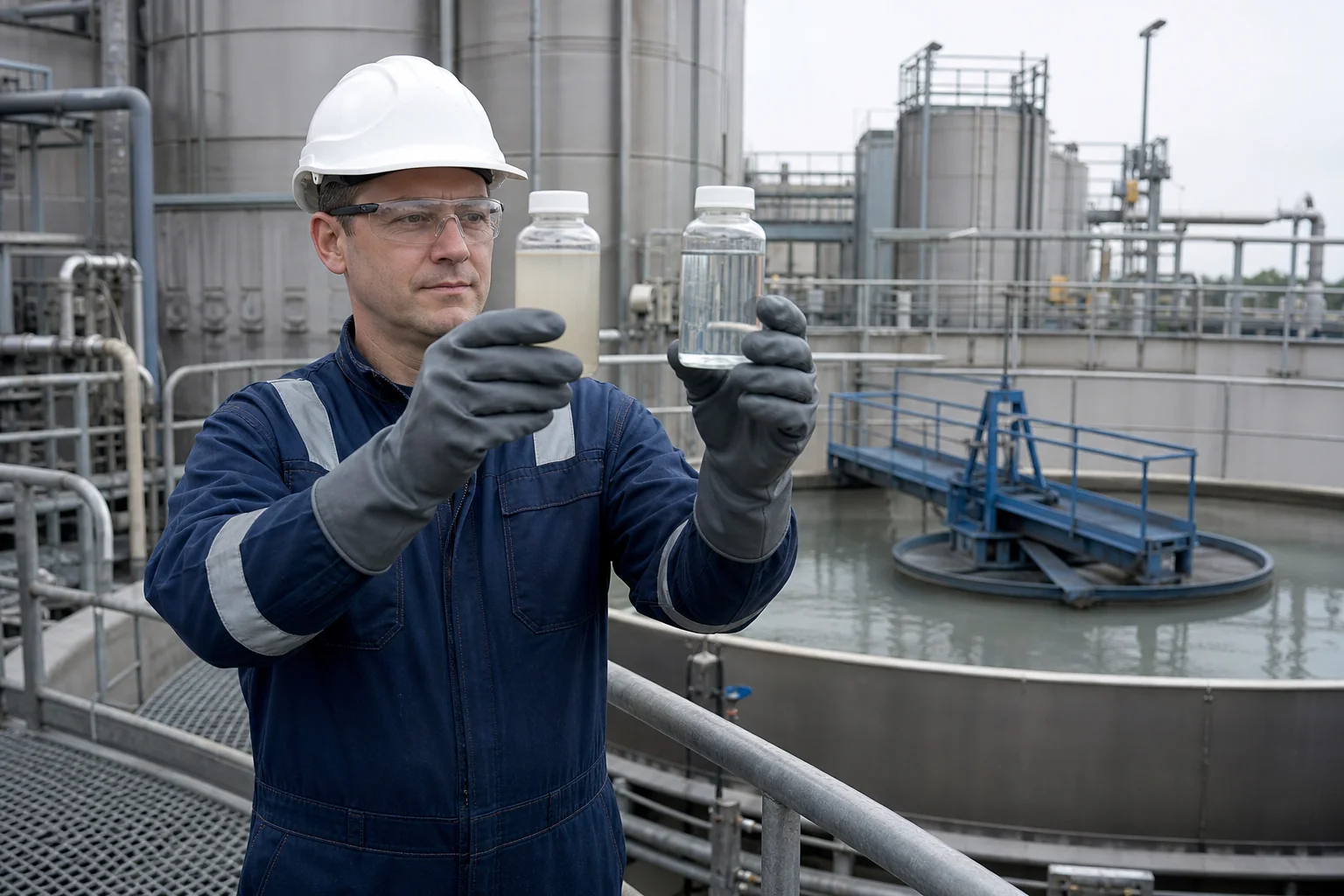
Ceramic wash-water purchasing should identify the stream and the intended reuse or treatment duty. Clay, polishing fines and glaze-related residuals can have different chemistry. A nonionic candidate needs representative comparison; the ceramic label cannot establish product fit or complete contaminant removal.
Separate unlike residual streams
Describe the collection point and whether body preparation, washing, polishing or glaze-related material is combined. Record solids and relevant chemistry available from the plant. Keep any additional treatment requirement visible rather than assume that flocculation alone addresses every constituent. Samples should reproduce the intended treatment stage, including its upstream reagents, not a simplified clean mineral mixture.
Test nonionic against practical alternatives
Hold the primary treatment and preparation conditions controlled while comparing candidates and dose. Measure settling and water quality at consistent times. The controlled trial guide is useful when pH or precipitation is relevant, without suggesting every ceramic stream is acidic. A family label is a hypothesis to test, not a fixed industry purchasing specification.
Include reuse and sediment handling
Assess recovered-water requirements with the responsible production team. Observe compaction, transfer and filtration where residual solids are dewatered. A clear jar can be incomplete if reused water or sticky sediment creates another constraint. The filter-press review helps retain the solids route. Clarification does not establish unrestricted suitability for every ceramic production step.
Qualify the actual supply-period envelope
Record candidate identity, preparation and the feed range represented by the comparison. Include production-related changes and the point that triggers another review. Estimate consumption from measured duty rather than product name alone. Confirm handling and commercial terms for the accepted grade. Separate first sample approval from a repeat order intended to cover an untested mix of residual streams.
Keep an approval worksheet
Record the measured result or agreed document reference for each item. A missing observation remains a qualification limit, not an assumed pass. Use the same candidate identifier throughout sampling, quotation and receiving so a successful comparison cannot be transferred to an unreviewed product or process condition.
| Requirement | Evidence | Approval decision |
|---|---|---|
| Stream mix | Clay, polishing and glaze-related contributions | RFQ targets a defined treatment feed |
| Whole result | Water quality, compaction and filter evidence | Selection balances reuse and residual handling |
| Supply range | Product code and tested production cases | Approval does not become an industry-wide promise |
Prepare the sample and quotation request
Provide wash-water origin, combined streams, upstream chemicals, solids and water range. Include separator, reuse requirements, current preparation and candidate results. State production changes expected during the order period and which conditions are already qualified.
Include quantity, packaging and destination alongside the operating record. The nonionic PAM sample worksheet helps define the comparison; the quality and supply requirements keep the approved product connected to its shipment. Gongyi Xinqi Polymer Co., Ltd. can review the application and commercial scope. Confirm grade suitability, delivery availability and terms for the selected candidate rather than infer a guaranteed result from the nonionic label.
Request a focused product review
Send feed, separator and purchasing requirements for the intended duty.