
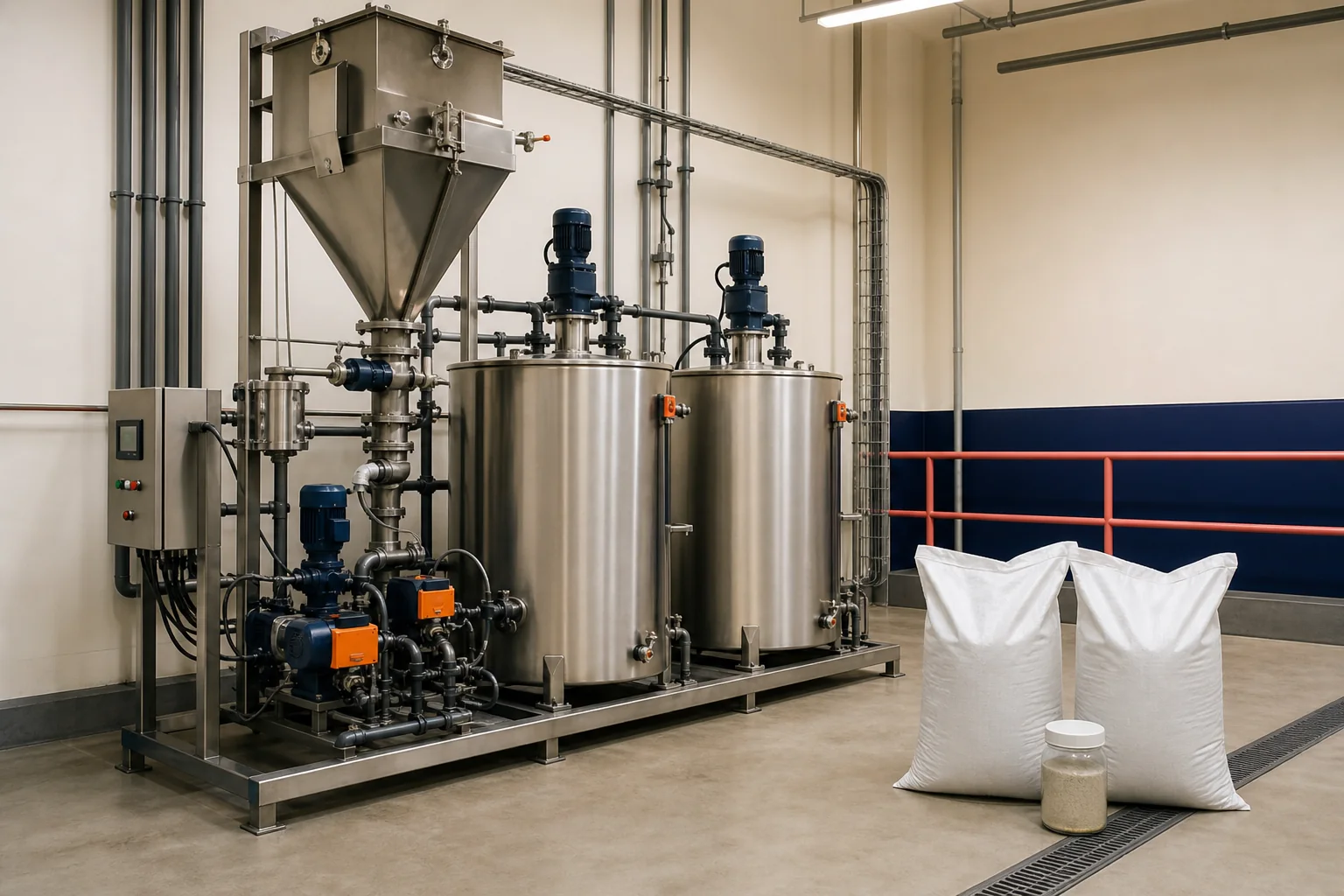
A correct nonionic PAM grade can appear ineffective when powder wets unevenly, the stock is too concentrated, maturation is shortened or the solution is damaged before injection. Preparation belongs in the product trial record.
Measure water and powder
Record make-down water source, temperature, pH, conductivity and hardness. Calibrate dry-feeder output at several settings and measure water flow independently. Keep bags, hopper and feeder dry to prevent premature swelling.
Induct powder without clumps
Create a stable water stream or vortex before introducing powder gradually. Avoid dumping powder onto a stagnant surface. Observe the wetting zone and correct air entrainment, wall deposits and feed surges. Never sweep spilled dry polymer into a wet drain.
Choose a workable concentration
Use a stock concentration the mixer and pumps can handle and document the active basis. Excessively concentrated stock can distribute poorly even when fully dissolved. Secondary dilution near the injection point can increase contact area without changing active dose.
Mix and mature deliberately
Use enough initial agitation to disperse particles, then gentle movement during hydration. Determine actual residence from working volume and demand rather than nameplate volume. Prevent fresh stock from short-circuiting into the day tank.
Verify solution quality
Inspect for fisheyes, gel fragments and screen residue. Compare solution appearance or viscosity trend at planned ages and run a simple treatment check. If performance improves with age, the plant maturation window is too short.
Protect the solution in transfer
Review high-speed pumps, tight valves, recirculation and long aging. Confirm pump compatibility and avoid unnecessary shear. Flush lines safely according to operating procedures and the SDS.
Record every preparation variable
Keep grade and lot, water, concentration, feeder calibration, start time, maturation, tank level, pump setting and application result. Use the fast-dissolving profile only after this baseline is known.
Set acceptance limits before testing
For a nonionic PAM make-down audit, write the acceptance condition before polymer is added. Define the feed range, sampling point, baseline treatment and operating time represented by each sample. A trial cannot be compared fairly if the feed or primary chemistry changes while candidates are being ranked.
Use a numerical or clearly observable endpoint: fisheye-free solution, stable viscosity trend, calibrated active delivery and repeatable treatment response. Record the method, sample timing and instrument condition. Include an operating constraint such as residence, pump capacity, filter cycle or downstream recovery so a visually attractive result does not hide a plant penalty.
Bracket normal feed variation
Build at least two feed cases around water temperature and chemistry, feeder rate, tank demand, maturation time and solution age. Test the same candidate set and active-dose steps on both. A narrow optimum on one easy sample is less useful than a broader response that remains controllable through the expected production envelope.
Keep preparation water, stock concentration, maturation, solution age and mixing sequence identical. When one variable must change, run a bridge comparison so the chemistry effect can be separated from the preparation effect.
Read the full response curve
Plot the blank, current product and candidate results against active dose. Mark the first useful response, the stable operating region and the point where more addition gives no benefit or reverses performance. Repeat the middle and high points before deciding that overdose has been located.
When laboratory stock works but plant stock does not, or performance changes with tank level and demand, stop changing several variables together. Check sample integrity, precipitation or coagulation, polymer stock, dose calculation, distribution and shear in that order. Only then compare a different molecular or ionic profile.
Carry the result into the plant
For scale-up, correct feeder, water and residence measurements before testing an alternative fast-dissolving profile. Allow the full hydraulic or recycle residence after each change. Collect feed and product samples at matched times, keep equipment settings stable and record operator observations alongside laboratory measurements.
Convert pump settings and solution flow back to active polymer consumption. Reconcile the calculated value with inventory over a stable period. Differences often expose feeder calibration, tank turnover, dilution or recirculation errors that were invisible in the jar test.
Close the technical and purchasing record
Retain the product code, lot, preparation sheet, dose curve, photographs, instrument readings and plant result. State the approved feed range and the condition that requires retesting. This keeps a successful sample connected to the material later ordered and received.
Request COA, TDS and SDS for the exact grade. Compare packaging, freight, storage, make-down demand, active consumption and separation value as delivered treatment cost. Do not replace application evidence with a single molecular-weight, viscosity or hydrolysis number.